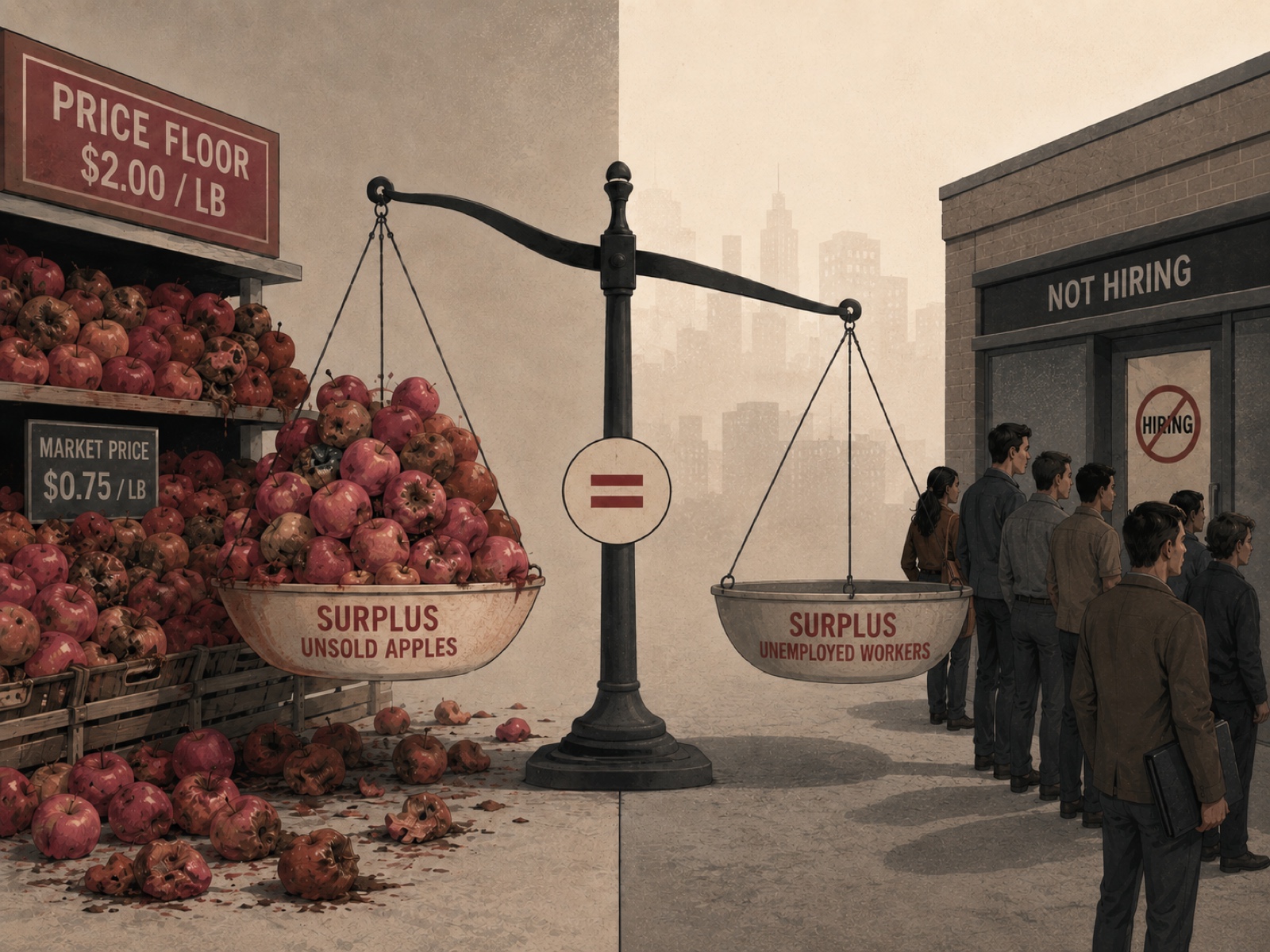
Few economic policies feel as obviously kind as raising the minimum wage. The real claim behind it is bigger than kindness. It is the claim that a higher wage floor always helps workers, at no real cost. That word, always, is the part worth testing. You do not even need a chart to see the problem. The logic gives it away first, and the data only confirms what the logic already predicts.
The theory comes first
Before any study, the case against the idea that a minimum wage always helps workers can be made on reasoning alone. Here it is, in nine short steps.
- A wage is a price, not a gift. An employer pays you because your work is worth at least that much to them. Force the price above what the work produces and they have three options: absorb the loss, raise prices, or stop hiring you. At the margin, the third one wins. A law can set the price of work. It cannot raise what the work is worth.
- Price floors create gluts, and labor is no exception. Set any price above what a market will bear and you get a surplus, more supply than demand. Do it to apples and they rot on the shelf. Do it to labor and the surplus has a name: unemployment. The only honest debate is about size, not direction.
- The word always cannot survive real differences between workers. One person's hour of work is worth $25, another's is worth $9. A $15 floor makes nobody more productive. It simply makes the $9 worker illegal to hire. So the policy does not help workers as a group. It helps some by sacrificing others.
- The cost does not vanish. It moves. The raise you can see is real. So is what you cannot see: the job that never opened, the shop that quietly closed, the self service till that replaced the cashier, the hours trimmed from the schedule, the higher prices paid by the same low income shoppers the policy meant to help. Honest accounting counts both columns.
- The bite matters more than the dollar. A $15 floor in Manhattan, where the median wage is near $35 an hour, barely binds. The same $15 in rural Mississippi, where the median is closer to $17, is crushing. One national number lands hardest exactly where workers are poorest. The OECD tracks this as the Kaitz index for precisely this reason.
- It is a tax on hiring the least skilled, paid by them. A higher minimum does not raise what a worker brings in. It only raises what they cost. So the first people priced out are the weakest résumés: teenagers, immigrants still learning the language, former offenders, school leavers. They are the very workers the policy claims to protect.
- A first job is training, not just a paycheck. It teaches showing up on time, taking direction, handling customers, the skills that move you up. Cut away the bottom rung and you do not just lose a wage. You lose the ladder. Workers stay stuck at the bottom because the bottom no longer exists.
- If it is free, why not $50 an hour? Anyone who insists a hike costs no jobs still has a number at which they would admit it obviously would. That admission proves the effect is real. The argument is only ever about where the line sits, never about whether one exists.
- Wages are a result, not a cause. Rich countries do not get rich by ordering high pay. They pay well because their workers produce a lot. Mandate high wages without the productivity and you do not create wealth. You price the least productive out of legal work, into the shadow economy, onto welfare, or out of the labor force. You cannot get rich by passing a law.
What the research shows
Theory predicts harm concentrated at the margin. When economists go and measure, that is broadly what they find. Four lines of evidence, with their sources.
The most thorough survey of the modern U.S. literature gathered essentially every credible study and reported a “clear preponderance of negative estimates,” with 79.3% of the estimated employment elasticities negative. Roughly four in five studies find that minimum wage increases reduce employment, and the effect is strongest for teens, young adults, and the less educated.
When Seattle raised its minimum toward $13, hours worked in low wage jobs fell about 9% while hourly pay rose only about 3%. The net effect cut the typical low wage worker's earnings by an average of $74 a month. The raise was eaten by lost hours.
The widely quoted figure of “$125 a month” comes from the original 2017 draft. The published paper revised the average loss down to $74 a month per job.
One year after California's $20 fast food minimum took effect, an analysis of Bureau of Labor Statistics data attributed a 14.5% rise in fast food prices, nearly double the national average, plus roughly 10,700 lost fast food jobs, to the policy.
In fairness, the fight here is unresolved. A competing UC Berkeley IRLE study (Michael Reich and Denis Sosinskiy, 2025) finds much smaller effects: irle.berkeley.edu (PDF).
Studying who actually benefited from New Jersey's 1992 hike, the average family income of minimum wage workers rose by just 1%. Fewer than 10% of beneficiaries were in families earning under $10,000. 70% were in families earning over $20,000, and the average benefiting family made about $39,000. Nearly half the beneficiaries were under 25.
None of this proves that a minimum wage is always harmful, everywhere, at every level. That would be its own myth. It proves the opposite of the original claim. The wage floor is a trade off, not a free gift. It helps the workers who keep their jobs and hurts the ones who lose the chance at one, and the second group is invisible precisely because they were never hired. “Always helps” is the one thing that the logic and the evidence agree it cannot be.